![]() |
| The New Woman (Maggs Bros, catalogue 1517) |
Wednesday, April 26, 2023
612. Michael Field in a Collection of Books by New Women
Wednesday, April 19, 2023
611. Silverpoints on an American Shelf
Only a minority of book collectors write about their collection, but some collectors actually enjoy writing about the books they surround themselves with.
Wednesday, April 12, 2023
610. Ricketts and Shannon in a Limerick
As they gradually became famous personalities in the art world - exhibitions, articles and opinions on museums and art purchases made them more familiar - Ricketts's and Shannon's names popped up in unexpected quarters.
![]() |
| R.D. [Randall Davies], A Lyttel Booke of Nonsense (1912, cover) |
John Aplin found a reference to a limerick in a letter from Charles Ricketts to Sydney Cockerell, dated 10 May 1912. Ricketts quoted the limerick, which he found 'charming' (BL Add MS 52746, f 66).
![]() |
| R.D. [Randall Davies], A Lyttel Booke of Nonsense (1912, title page) |
The poem was published in an edition whose author hid behind the initials R.D., but Ricketts knew they stood for Randall Davies and presumably he received A Lyttel Booke of Nonsense as a gift from the author. Randall Robert Henry Davies (1866-1946) was a major collector of old masters, drawings and English watercolours, who as a young man befriended Herbert Horne, became his executor, and edited the catalogue of Horne's art collection. He wrote several books about artists, Chelsea architecture, caricatures, and watercolours. Portraits of Davies were painted by James Kerr-Lawson and Glyn Philpot (who had also portrayed the artist Gladys Miles, who later married Davies) and, additionally, there is a bronze buste by Romano Romanelli. In 1930, Davies was selected by the Trustees of the Melbourne National Gallery to buy paintings in London.
![]() |
James Kerr-Lawson, portrait of Randall Davies [Chelsea Library, London] |
The manager of the Vale Press, Charles Holmes, knew Davies, and Ricketts may have known Davies as well.
![]() |
| R.D. [Randall Davies], A Lyttel Booke of Nonsense (1912, page 139) |
A Lyttel Booke of Nonsense was published in 1912 by Macmillan & Co. Ltd. The old-fashioned spelling of the title was chosen to match the woodcuts collected by the author, which were about four hundred years old at the time.
![]() |
| R.D. [Randall Davies], A Lyttel Booke of Nonsense (1912, poem on page 138) |
Most limericks are about 'an old fellow called Cox', 'a young housemaid at Ashdown' and 'a young lady called Mabel'. Only three actual persons appear in it. The third (page 138) is a sportsman mentioned in a limerick about an amateur golfer who fears he shall 'never beat Vardon'. Henry Vardon (1870-1937) was a famous golfer from Jersey.
Two persons more familiar to us are mentioned on page 126:
There was a young Lady of Annan,Whose father-in-law was a Canon;
But she gave up the Church
For artistic research,
And consorted with Ricketts and Shannon.
![]() |
| R.D. [Randall Davies], A Lyttel Booke of Nonsense (1912, poem on page 126) |
Wednesday, April 5, 2023
609. "The Property of J.G. Paul Delaney"
On 30 March 2023, Forum Auctions' Fine Books, Manuscripts and Works on Paper included a 'Private Press & Limited Editions' section, the first part of which was presented as 'The Property of J.[G.] Paul Delaney, author of a biography and other books on Charles Ricketts'. These lots, numbered 471 to 479, do not comprise the complete collection of Delaney, who returned to his native Canada years ago after a long stint in London - previously he sold exceptional items from his collection, such as letters from Ricketts and Shannon.
The books did remarkably well at this auction and easily reached the highest estimates, with the exception of the last lot that contained a single book: The Parables from the Gospels (1903); hammer price was £300 - against an estimate of £400-£600. Recent hammer prices for this book were £350 (2020), £460 (2021), €650 (2022), £320 (2022), and prices ranged between US$2,400 (2020), £1,475 (2021), £2,000 (2022). Delaney's copy went for a low price.
![]() |
| Marlowe, Hero and Leander (wood engravings by Charles Ricketts and Charles Shannon) 1894 |
The only other lot containing one work was lot 474: Marlowe's Hero and Leander with wood-engravings by Ricketts and Shannon (1894). Hammer price was the highest estimate: £1,000.
The remaining seven lots in this auction were composed around particular authors, such as Gordon Bottomley and Oscar Wilde, while other lots included small collections of editions by Ricketts or the Vale Press.
An interesting stowaway aboard lot 473 was a book from Ricketts's own library - Ricketts, by the way, was not a neat librarian; many of his books show that his books were there for his daily use, not for his aesthetic pleasure. In this case, it was a monograph on furniture: Wilhelm Bode's Die Italienischen Hausmöbel der Renaissance (Leipzig, 1907). The lot contained thirty-four other works and the hammer price was £1,000.
![]() |
| Oscar Wilde, The Picture of Dorian Gray (1891) |
Most lots fetched around £1,000, but there was an upward exception. The second lot in this section of the auction consisted of four books by Oscar Wilde: a first edition of The Picture of Dorian Gray, a copy of Lord Arthur Savile's Crime & Other Stories, a second edition of Intentions and a copy of the play A Woman of No Importance. None of these books was in ideal condition. Terms such as 'rubbed', 'foxed', 'soiled', 'rather rubbed and soiled' applied to all four, but for Wilde's novel it applied in extenso: the spine was damaged at the top, had a transverse tear halfway down the spine and the spine was almost detached from the covers.
The upside was that no restoration attempts had been made and all parts were original. Perhaps this was appreciated. Anyway, initial bids immediately exceeded estimates of £1,000 to £1,500 and the hammer price was £3,800.
Wednesday, March 29, 2023
608. The Binder of Ricketts's Beyond the Threshold (1929)
The book itself gives no clues about the binder. The binding does mention the designer's monogram ("CR"), but not that of the bookbinder, nor does the turn-in - where the bookbinder's name is sometimes stamped - mention a name.
![]() |
| Charles Ricketts, Beyond the Threshold (1929) turn-in at the back of the book |
The colophon is equally sparse with details, and information about the edition and paper are absent. However, the printer is mentioned: 'PRINTED IN ENGLAND AT THE CURWEN PRESS PLAISTOW MCMXXIX'.
![]() |
| Charles Ricketts, Beyond the Threshold (1929) colophon |
This could point us in a certain direction. During the interwar period, the Curwen Press was one of the leading modern printing houses in Britain, where the teams of typographer Oliver Simon and printer Harold Curwen worked together to produce books that could stand any test of criticism. The First Edition Club had several books printed there, such as A Bibliographical Catalogue of the First Loan Exhibition of Books and Manuscripts Held by The First Edition Club 1922 (1922) and Book Clubs & Printing Societies of Great Britain and Ireland (1929).
One of the major financial successes of the Curwen Press in those years was The Legion Book, which was reprinted many times. This is where it gets interesting, because the deluxe first edition of this book - which I wrote about earlier - featured a binding designed by Ricketts that was executed by Henry T. Wood Limited in London. The book included a statement to that effect.
![]() |
| The Legion Book (1929) turn-in with the name of Wood, London |
Can we find a connection between the First Edition Club, Charles Ricketts and Henry T. Wood Limited? Yes, that is entirely possible.
All the special bindings for The First Edition Club Binding Group have been entrusted to the old-established firm of Henry T. Wood Limited.
A later binding, for the Letters from Aubrey Beardsley to Leonard Smithers (The First Edition Club, 1937), was, however, executed by Leighton-Straker-Bookbinding Co.
However, in the first volume of The Book-Collector’s Quarterly (1930-1931), Wood was the only bookbinder among the advertisers.
![]() |
| The Book-Collector's Quarterly, October-December 1931 |
Perhaps - because of the short interval between Beyond the Threshold and The Legion Book - we may assume that the binding of Beyond the Threshold was executed by Henry T. Wood.
Wednesday, March 22, 2023
607. Ricketts's Drawings for Oscar Wilde's Prose Poems (1924)
In 1924, Charles Ricketts made a series of drawings for (a never realised) edition of Oscar Wilde's prose poems. The set was sold (along with a set of new drawings for Wilde's The Sphinx) in America. None of this set of eight drawings were known in the 1970s.
There was a set of preparatory sketches though (and there were earlier ones, probably executed around 1894, and found again in 1918). The preparatory sketches ended up in the Tullie House Museum and Art Gallery in Carlisle. (For these, see blog 97: Pen and Ink Drawings in My Earliest Manner).
The American drawings differ from the sketches: they are signed with Ricketts's monogram 'CR'. Moreover, the original sketches were made on paper prepared with a variety of colours, while the American sketches were drawn on white paper.
After completing them, Ricketts wrote to Gordon Bottomley that he had 'executed eight drawings in my old manner illustrating Wilde's Poems in Prose' (Charles Ricketts to Gordon Bottomley, 13 June 1924: BL Add MS 61719).
How many can we trace today?
Two of these drawings are in the Arts Institute of Chicago and are described and illustrated on the museum's website: 'The Hermet' and 'Narcissus by the Pool'. In 1925, both were given to the museum by philanthropist Robert Allerton (1873-1964).
A third one, exhibited in 1979, but not known to me until recently, is in the RISD Museum in Providence, Rhode Island. This is the drawing for 'The Teacher of Wisdom'.
This drawing has been catalogued as: pen and ink off-white, medium weight wove paper, 229x152 cm, signed l.r.: “CR”, Gift of the estate of Mrs. Gustav Radeke. Eliza Greene Metcalf Radeke (1854-1931) was another patron of the arts, and seventh President of the Rhode Island School of Design (in office 1913–1931). Her alma mater was Vassar College, Brown University. She was a client of the art dealer Martin Birnbaum who sold the Ricketts drawings in America. The drawing was exhibited in 1979, 1991, and 2006, and illustrated in the 1979 catalogue by Diana L. Johnson, Fantastic Illustration and Design in Britain, 1850-1930.
The final drawing for 'The Teacher of Wisdom' is neater than the sketch. Whereas the sketch shows improvements in Chinese white and newly drawn lines, the later drawing comes without improvements. Lines have been drawn together, messy details tightened. The rock outline along the right side of the drawing, for example, is simpler, lacking subdivisions, making the landscape look more harsh and monolithic. Overall, however, the drawing is faithful to the sketch.
Wednesday, March 15, 2023
606. A Caricature of Charles Ricketts by Walford Graham Robertson
From about 1910, Ricketts and Shannon became public figures who were therefore regularly photographed, appeared in news reports or became the subject of satire and caricatures.
An unknown cartoon, actually an affectionate portrait of Ricketts, remained unpublished until recently Daniel Mailford Cottam devoted a blog on the site of the V&A in London to a series of drawings in the collection. [Read the full text of his blog with all the illustrations here.] The artist is Walford Graham Robertson (1866-1948).
![]() |
| Walford Graham Robertson, The Saga of Letitia and Rachel, No.20. [V&A London, bequeathed by Guy Tristram Little: E.2731-1953] |
A handwritten explanation accompanying this image reads:
The revel is at its height. All is innocent gaiety and intellectual relaxation. The Archbishop of Canterbury is approaching Mr Epstein on the subject of a heroic and symbolic statue of himself for presentation to the Luxembourg by Mr Edmund Davis. In the cloakroom (where the crush is terrific) Mr Ricketts is kindly running up a little costume for M Nijinski who, from force of habit, has come without one.The dancer Vaslav Nijinsky (1888-1950), who was greatly admired by Ricketts and whom he met several times, is at the front of the cloakroom, but is completely naked (as suggested by his costumes in one ballet). Ricketts sits on the counter like a tailor, busy sewing a colourful costume especially for him - these were the years when Ricketts was known for his stage costumes and the dancer for his performances in London.
Wednesday, March 8, 2023
605. A Vale Press Collector: Constance Astley (5)
At the end of the year 1941, Chas J. Sawyer in Grafton Street, London, sold Constance Astley's collection - without mentioning her name - via catalogue No. 166. Some Vale Press items were listed on pages 8, 9 and 10, but most were described in a separate section 'Vale Press' on pages 55 to 59. The catalogue does not contain all special copies from the collection and it describes books that were apparently not yet part of her collection in 1928.
![]() |
| The Book Beautiful. Chas J. Sawyer Ltd., 1941, catalogue No. 166 [The Grolier Club, New York] |
Books not listed in the sales catalogue
Duplicate copies on paper are not mentioned. This is easily explained: the description of one copy was sufficient and if several customers came for it, several copies happened to be available. This is not exceptional.
Only one of the two paper copies of Apuleius' Latin edition is therefore listed, and the same applies, for example, to the three-volume Shelley edition.
What may be surprising is that thirteen copies on vellum are not included in this catalogue. Surely inclusion could have made the Christmas catalogue much more attractive. A reason for the omission is anyone's guess. It is most likely that Sawyer already had buyers in mind, or, that collectors had already scooped up a few prizes.
However, because of this, both vellum copies of Blake's Poetical Sketches are missing, and exactly the same goes for Ricketts's Defence of the Revival of Printing and Michael Field's The Race of Leaves. The impression of Astley's collection is thus a lot poorer, simpler, less complete than it actually was.
![]() |
| The Book Beautiful. Chas J. Sawyer Ltd., 1941, catalogue No. 166, page 55 [The Grolier Club, New York] |
Books not listed in Astley's library catalogue
![]() |
| The Book Beautiful. Chas J. Sawyer Ltd., 1941, catalogue No. 166, page 56 [The Grolier Club, New York] |
Present locations of books from Astley's collection
![]() |
| The Book Beautiful. Chas J. Sawyer Ltd., 1941, catalogue No. 166, page 10 [The Grolier Club, New York] |
Wednesday, March 1, 2023
604. A Vale Press Collector: Constance Astley (4)
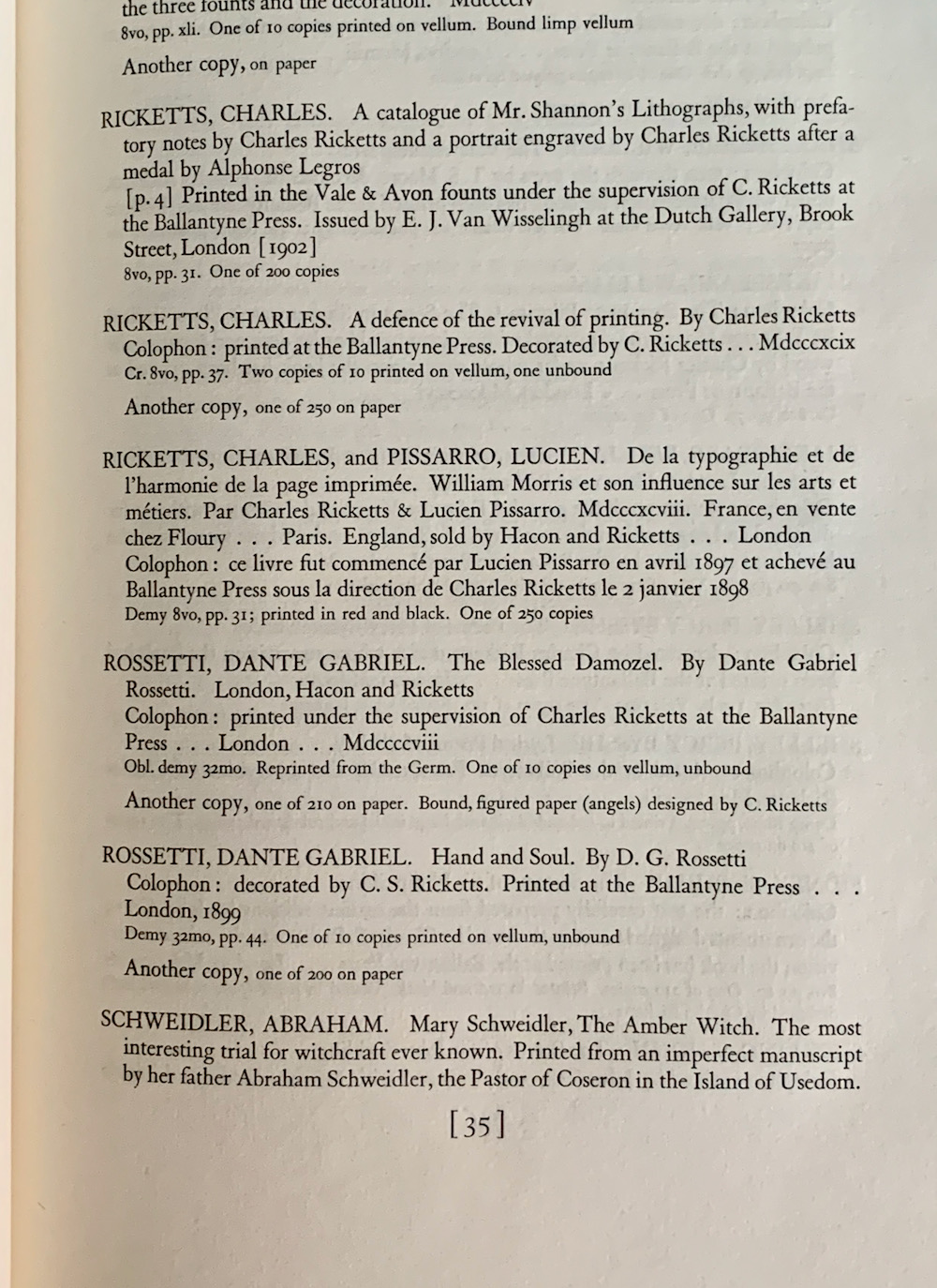
In the catalogue of Astley's collection, The Ashendene Press takes up five pages; The Daniel Press just over one, The Doves Press six; The Eragny Press five-and-a-half, The Essex House Press eight and The Kelmscott Press three-and-a-half. Ricketts's Vale Press also covers the maximum of almost eight pages (pp. 30-37).
Her general collection included other Ricketts-designed books, such as Thomas Hardy's Tess (1891), Wilde's De Profundis (1905) and Shaw's Saint Joan (1924), but his two main commercial designs from the 1890s were missing: Wilde's The Sphinx and John Gray's Silverpoints.
On the other hand, she did own copies of the two celebrated predecessors of the Vale Press, the editions of Daphnis and Chloe (1893) and Hero and Leander (1894), and the five issues of The Dial (1899-1897).
The Vale Press
Astley's Vale Press collection was described in forty-seven entries. In this section, too, multi-volume works are included as one item. Thus, the thirty-eight-volume Vale Shakespeare is documented in one brief catalogue description.
The Vale Press, like the Doves Press, must have been among her favourites - the collection was entirely complete. Not one edition was missing. All ninety volumes were present.
Moreover, multiple copies were acquired in many cases, adding another thirty-four books to her Vale Press collection that comprised 124 volumes, five or six shelves at least.
The earliest editions of the press and the later Vale Shakespeare were only printed on paper, there were no vellum editions of those books. However, there were thirty-six volumes printed on vellum, and Astley's bookshelves carried no less than seventeen copies printed on vellum. Three of those were accompanied by a second copy on vellum: twenty in all. Not bad for a collector without a system, she owned almost half of all existing vellum Vale Press editions. By now we can establish that her system of collecting private press editions was simple: don't miss an opportunity, buy all the copies you come across.
![]() |
| Catalogue of the Library of Constance Astley at Brinsop Court Herefordshire (1928) |
Astley mostly left the books in their original condition. The vellum copy of Thomas Browne's Religio Medici, for example, was 'One of 10 copies printed on vellum. Unbound.' We can hope that later owners left it that way, but I dread the worst: unbound copies of vellum editions are now extremely scarce.
Remarkably, Astley did not own a single copy in a unique book binding specially designed by Ricketts for a Vale Press book. However, there were a few Vale Press books in bindings by leading contemporary bookbinders, and, although few in number, all by women bookbinders.
Of Robert Browning's Dramatic Romances and Lyrics, Astley owned a copy on vellum bound in blue morocco - probably not after a design by Ricketts, and also a paper copy in a binding by 'Miss T.C. Yeatman', as well as another copy on paper, probably in the original white cloth binding. The Yeatman binding was probably commissioned by Astley, as it contains an autograph letter from the binder (according to the Sawyer 1941 sale catalogue).
![]() |
| Alfred Tennyson, In Memoriam (Vale Press, 1900) Binding (detail) by Sarah T. Prideaux [Collection: British Library, London] |
At the time the Vale Press was publishing a two-volume Tennyson edition, bookbinder Sarah Prideaux bought two copies which she bound. One set is now in the British Library, the In Memoriam volume of the other set ended up in Lisa Unger Baskin's collection and has since been transferred to Duke University Libraries in Durham, North Carolina. One of these must have been Astley's copies.
![]() |
| Alfred Tennyson, In Memoriam (Vale Press, 1900) Binding by Sarah T. Prideaux [Collection: Duke University, Durham: from the collection of Lisa Unger Baskin] |
Exceptional vellum copies
The books of which she managed to obtain two copies on vellum are:
Wednesday, February 22, 2023
603. A Vale Press Collector: Constance Astley (3)
Constance and Hubert Astley made long voyages to Tenerife, Egypt and America. A family house was located on Lake Como in Italy where they sometimes stayed for months; there were yacht parties, dinners and guests at Benham Valence. But when did she buy her books? How much time did she spend on collecting them? From whom did she acquire the luxury editions of private presses?
About her activities as a collector, we know nothing at all - we only know the 1928 interim result thanks to the catalogue of her collection and the state of her complete collection thanks to the sale catalogue issued after her death by Sawyer in 1941. Perhaps a comparison between the two could provide additional information?
![]() |
| Visitors Book The Cotswold Gallery [Private collection] |
Thanks to the guest book of a London art gallery, the Cotswold Gallery (private collection), we know that her husband Hubert D. Astley visited that gallery on 23 March 1922 (Ricketts signed the guestbook for the first time in April of that year). Was Constance Astley visiting antiquarian booksellers elsewhere in London while he devoted himself to art?
![]() |
| Visitors Book The Cotswold Gallery [Private collection] |
The Ashendene Press
The Ashendene Press, founded by St John Hornby (1867-1946), was still active when Astley published her catalogue in 1928. By then, thirty-six (out of a total of forty) books had already been published. Astley did not have them all.
In fact, she owned twenty-three editions and of half of them she owned multiple copies. Of Tutte le opera di Dante Alighieri Fiorentino, for example, she owned three copies; one of six on vellum and two of 106 on paper.
The oldest edition she owned of this press was published in 1899 - she apparently did not find the previous nine editions interesting.
Of the thirty-five copies in her collection, nineteen were on vellum.
The Daniel Press
The Daniel Press founded by Charles Henry Olive Daniel (1836–1919) and members of his family issued fifty-eight books of which Constance Astley owned thirteen books in 1928, including the very rare edition of The Garland of Rachel (1881) of which thirty-six copies were printed.
The Doves Press
T.J. Cobden-Sanderson and Emery Walker's Doves Press issued forty books between 1900 and 1916. Astley owned forty-one books, including one ephemeral publication (Ecce Mundus).
Astley's complete Doves Press collection totalled ninety-one copies; she often owned three copies of a book, sometimes two of which were on vellum. In her bookcase were copies of thirty-four Doves Press editions printed on vellum, with a second copy on vellum of nine of these. That brings the number of vellum copies, astoundingly, to forty-three. Many of these were bound by The Doves Bindery. One copy was bound by Edith J. Gedye (Essays by Ralph Waldo Emerson [as in the 1928 catalogue the name was often misspelt Gedge]). Gedye sometimes identified herself as a 'successor to Cobden Sanderson'. As a bookbinder, she started at Sangorski & Sutcliffe, and later settled in Bristol.
![]() |
| Gustave Flaubert, La légende de Saint Julien l'Hospitalier (Eragny Press, 1900). Copy bound by Sarah T. Prideaux (detail) [Collection British Library, London] |
The Eragny Press
Lucien and Esther Pissarro's Eragny Press published thirty-two books. Astley owned twenty-nine of them. The two Eragny books commissioned by French bibliophile societies were missing: the Nerval edition for the Société des Cent Bibliophiles and the Moselly book ordered by Le Livre Contemporain - obviously these were difficult to obtain in Great Britain. Also missing was the last book issued by Pissarro: Michael Field's Whym Chow (1914) of which a mere twenty-seven copies were printed.
Many of these books were present in multiple copies. The entire collection consisted of sixty-one copies.
For example, the three-volume Flaubert series (1900-01) was present in triplicate, with one set bound by Sarah T. Prideaux. At publication, Prideaux bound two such sets whose patrons are unknown. One of these sets is in the British Library (illustrated in Marianne Tidcombe's Women Bookbinders 1880-1920, 1996, p. 108; for colour illustrations see the BL Database of Bookbindings).
Astley acquired ten books of the press that were printed on vellum - of two of these books she owned two vellum copies.
Essex House Press
The Essex House Press was founded by C.R. Ashbee in 1898. The presses were sold in 1910 when ninety books had been published. Constance Astley owned fifty-two books of this private press.
Again, Astley collected multiple copies. Her Essex House row of books numbered sixty-three copies. Among them were eighteen books printed on vellum, but that is not exceptional in this case - twelve of these were part of editions of which the press only issued copies on vellum.
The Kelmscott Press
William Morris published fifty-three books at The Kelmscott Press, if we include the few that were finally issued after he died. Astley owned only twenty-four of them, but her collection included a copy of the Chaucer edition, the largest undertaking of the press.
Duplicates included, there were twenty-six Kelmscott Press editions, of which there were four copies printed on vellum. Astley owned both a vellum and a paper copy of the Chaucer edition and of Rossetti's Hand and Soul, a vellum copy of Morris's Of the Friendship of Amis and Amile, and a vellum copy of The Tale of King Florus and the Fair Jehane.
The Vale Press collection of Constance Astley will be the subject of next week's blog.
Wednesday, February 15, 2023
602. A Vale Press Collector: Constance Astley (2)
Following Constance Astley's death in 1940 - with her personal property valued at £58,151 - several auctions of household goods and books took place, including a two-day auction organised in 1944 by Russell, Baldwin and Bright held at Brinsop Court.
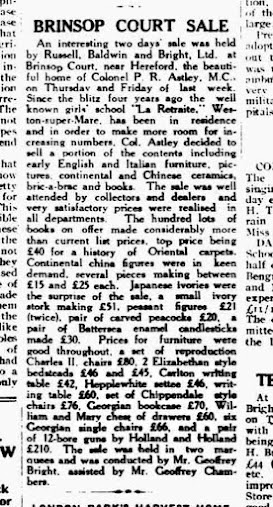
![]() |
| 'Brinsop Court Sale' (Kingston Times, 25 November 1944) |
English and Italian furniture and Chinese pottery changed hands, but so did 'books', according to the Kingston Times (25 November 1944):
Two hundred lots of books on offer made considerably more than current list prices, top price being £40 for a history of Oriental carpets.
In 1947, her son, Colonel P.R. Astley, sold more antiques, including silver, glass, pictures and prints. (Kingston Times, 8 February 1947).
However, her collection of special editions of English private presses had left Brinsop Court earlier, shortly after her death. The entire collection was sold, without a preface about the collector, anonymously, in London by the antiquarian firm of Chas. J. Sawyer Ltd. in Grafton Street. The catalogue, dated 1941 and numbered 166, was entitled "The Book Beautiful" and the subtitle described the collection roughly as:

.jpeg)