Wednesday, March 29, 2023

608. The Binder of Ricketts's Beyond the Threshold (1929)

Regularly I receive questions from collectors, and the most straightforward questions are often the hardest to answer. Last week, a bookbinder asked me about the binding of Charles Ricketts's 1929 Beyond the Threshold: 'In this case I wonder if you know which bindery made the 150 copies - I have an idea it could be Riviere & Son.' My initial response was that I considered that unlikely, but would attempt to find out. Promptly came a second suggestion: 'Perhaps the binder was Leighton - they did a lot of large gilt block-work'.

At the time of the Vale Press (1896-1904), Ricketts did indeed have special copies and even entire runs bound by Riviere and Son, Zaehnsdorf and J. & J. Leighton, but with a late work such as Beyond the Threshold, it is questionable whether he commented on possible binderies or left the choice to others.

Charles Ricketts, Beyond the Threshold (1929)
"CR" monogram

Beyond the Threshold is a difficult case because it was not a commercial edition, but an obscure combination of a private edition by Ricketts and an edition coordinated by A.J.A. Symons on behalf of the First Edition Club. Copies were traded only by Symons; Ricketts gave at least a dozen copies, if not more, as gifts to friends. Financially, the business was handled by the First Edition Club who also paid Ricketts for the brass plate made for the execution of the cover he designed.

The book itself gives no clues about the binder. The binding does mention the designer's monogram ("CR"), but not that of the bookbinder, nor does the turn-in - where the bookbinder's name is sometimes stamped - mention a name.

Charles Ricketts, Beyond the Threshold (1929)
turn-in at the back of the book

The colophon is equally sparse with details, and information about the edition and paper are absent. However, the printer is mentioned: 'PRINTED IN ENGLAND AT THE CURWEN PRESS PLAISTOW MCMXXIX'.

Charles Ricketts, Beyond the Threshold (1929)
colophon

This could point us in a certain direction. During the interwar period, the Curwen Press was one of the leading modern printing houses in Britain, where the teams of typographer Oliver Simon and printer Harold Curwen worked together to produce books that could stand any test of criticism. The First Edition Club had several books printed there, such as A Bibliographical Catalogue of the First Loan Exhibition of Books and Manuscripts Held by The First Edition Club 1922 (1922) and Book Clubs & Printing Societies of Great Britain and Ireland (1929).

One of the major financial successes of the Curwen Press in those years was The Legion Book, which was reprinted many times. This is where it gets interesting, because the deluxe first edition of this book - which I wrote about earlier - featured a binding designed by Ricketts that was executed by Henry T. Wood Limited in London. The book included a statement to that effect.

The Legion Book (1929)
turn-in with the name of Wood, London

Can we find a connection between the First Edition Club, Charles Ricketts and Henry T. Wood Limited? Yes, that is entirely possible. 

An exhibition of 132 examples of English bookbindings at the First Edition Club in January 1934 included 'transparent vellum bindings, designed by Mr. Kenneth Hobson and executed by Messrs. Henry T. Wood, Limited' (The Times, 4 January 1934).

The Book-Collector's Quarterly, April-June 1935

The bookbinder placed an ad in The Book-Collector’s Quarterly (April-June 1935), which was issued by The First Edition Club:

All the special bindings for The First Edition Club Binding Group have been entrusted to the old-established firm of Henry T. Wood Limited.


A later binding, for the Letters from Aubrey Beardsley to Leonard Smithers (The First Edition Club, 1937), was, however, executed by Leighton-Straker-Bookbinding Co.


However, in the first volume of The Book-Collector’s Quarterly (1930-1931), Wood was the only bookbinder among the advertisers.


The Book-Collector's Quarterly,
October-December 1931

Perhaps - because of the short interval between Beyond the Threshold and The Legion Book - we may assume that the binding of Beyond the Threshold was executed by Henry T. Wood.

Wednesday, March 22, 2023

607. Ricketts's Drawings for Oscar Wilde's Prose Poems (1924)

In 1924, Charles Ricketts made a series of drawings for (a never realised) edition of Oscar Wilde's prose poems. The set was sold (along with a set of new drawings for Wilde's The Sphinx) in America. None of this set of eight drawings were known in the 1970s.

There was a set of preparatory sketches though (and there were earlier ones, probably executed around 1894, and found again in 1918). The preparatory sketches ended up in the Tullie House Museum and Art Gallery in Carlisle. (For these, see blog 97: Pen and Ink Drawings in My Earliest Manner).

Charles Ricketts, 'The Teacher of Wisdom'
(preparatory sketch, c. 1924)
[Location: Tullie House Museum & Art Gallery, Carlisle]
[© With permission of the executors of the Charles Ricketts estate,
Leonie Sturge-Moore and Charmain O'Neil]


The American drawings differ from the sketches: they are signed with Ricketts's monogram 'CR'. Moreover, the original sketches were made on paper prepared with a variety of colours, while the American sketches were drawn on white paper. 

After completing them, Ricketts wrote to Gordon Bottomley that he had 'executed eight drawings in my old manner illustrating Wilde's Poems in Prose' (Charles Ricketts to Gordon Bottomley, 13 June 1924: BL Add MS 61719).

How many can we trace today?

Two of these drawings are in the Arts Institute of Chicago and are described and illustrated on the museum's website: 'The Hermet' and 'Narcissus by the Pool'. In 1925, both were given to the museum by philanthropist Robert Allerton (1873-1964).

A third one, exhibited in 1979, but not known to me until recently, is in the RISD Museum in Providence, Rhode Island. This is the drawing for 'The Teacher of Wisdom'.

Charles Ricketts, 'The Teacher of Wisdom' (1924)
[Location: RISD Museum, Providence, Rhode Island]
[©With permission of the executors of the Charles Ricketts estate,
Leonie Sturge-Moore and Charmain O'Neil]


This drawing has been catalogued as: pen and ink off-white, medium weight wove paper, 229x152 cm, signed l.r.: “CR”, Gift of the estate of Mrs. Gustav Radeke. Eliza Greene Metcalf Radeke (1854-1931) was another patron of the arts, and seventh President of the Rhode Island School of Design (in office 1913–1931). Her alma mater was Vassar College, Brown University. She was a client of the art dealer Martin Birnbaum who sold the Ricketts drawings in America. The drawing was exhibited in 1979, 1991, and 2006, and illustrated in the 1979 catalogue by Diana L. Johnson, Fantastic Illustration and Design in Britain, 1850-1930.

The final drawing for 'The Teacher of Wisdom' is neater than the sketch. Whereas the sketch shows improvements in Chinese white and newly drawn lines, the later drawing comes without improvements. Lines have been drawn together, messy details tightened. The rock outline along the right side of the drawing, for example, is simpler, lacking subdivisions, making the landscape look more harsh and monolithic. Overall, however, the drawing is faithful to the sketch.

Wednesday, March 15, 2023

606. A Caricature of Charles Ricketts by Walford Graham Robertson

From about 1910, Ricketts and Shannon became public figures who were therefore regularly photographed, appeared in news reports or became the subject of satire and caricatures.

An unknown cartoon, actually an affectionate portrait of Ricketts, remained unpublished until recently Daniel Mailford Cottam devoted a blog on the site of the V&A in London to a series of drawings in the collection. [Read the full text of his blog with all the illustrations here.] The artist is Walford Graham Robertson (1866-1948).

Walford Graham Robertson, The Saga of Letitia and Rachel, No.20.
[V&A London, b
equeathed by Guy Tristram Little: E.2731-1953]

A handwritten explanation accompanying this image reads:

The revel is at its height. All is innocent gaiety and intellectual relaxation. The Archbishop of Canterbury is approaching Mr Epstein on the subject of a heroic and symbolic statue of himself for presentation to the Luxembourg by Mr Edmund Davis. In the cloakroom (where the crush is terrific) Mr Ricketts is kindly running up a little costume for M Nijinski who, from force of habit, has come without one.

The dancer Vaslav Nijinsky (1888-1950), who was greatly admired by Ricketts and whom he met several times, is at the front of the cloakroom, but is completely naked (as suggested by his costumes in one ballet). Ricketts sits on the counter like a tailor, busy sewing a colourful costume especially for him - these were the years when Ricketts was known for his stage costumes and the dancer for his performances in London.

Daniel Mailford Cotton's blog is a wonderful read.

See V&A website: The Saga of Letitia and Rachel.

Wednesday, March 8, 2023

605. A Vale Press Collector: Constance Astley (5)

At the end of the year 1941, Chas J. Sawyer in Grafton Street, London, sold Constance Astley's collection - without mentioning her name - via catalogue No. 166. Some Vale Press items were listed on pages 8, 9 and 10, but most were described in a separate section 'Vale Press' on pages 55 to 59. The catalogue does not contain all special copies from the collection and it describes books that were apparently not yet part of her collection in 1928. 

The Book Beautiful.
Chas J. Sawyer Ltd., 1941,
catalogue No. 166
[The Grolier Club, New York]


Books not listed in the sales catalogue

Duplicate copies on paper are not mentioned. This is easily explained: the description of one copy was sufficient and if several customers came for it, several copies happened to be available. This is not exceptional.

Only one of the two paper copies of Apuleius' Latin edition is therefore listed, and the same applies, for example, to the three-volume Shelley edition.

What may be surprising is that thirteen copies on vellum are not included in this catalogue. Surely inclusion could have made the Christmas catalogue much more attractive. A reason for the omission is anyone's guess. It is most likely that Sawyer already had buyers in mind, or, that collectors had already scooped up a few prizes. 

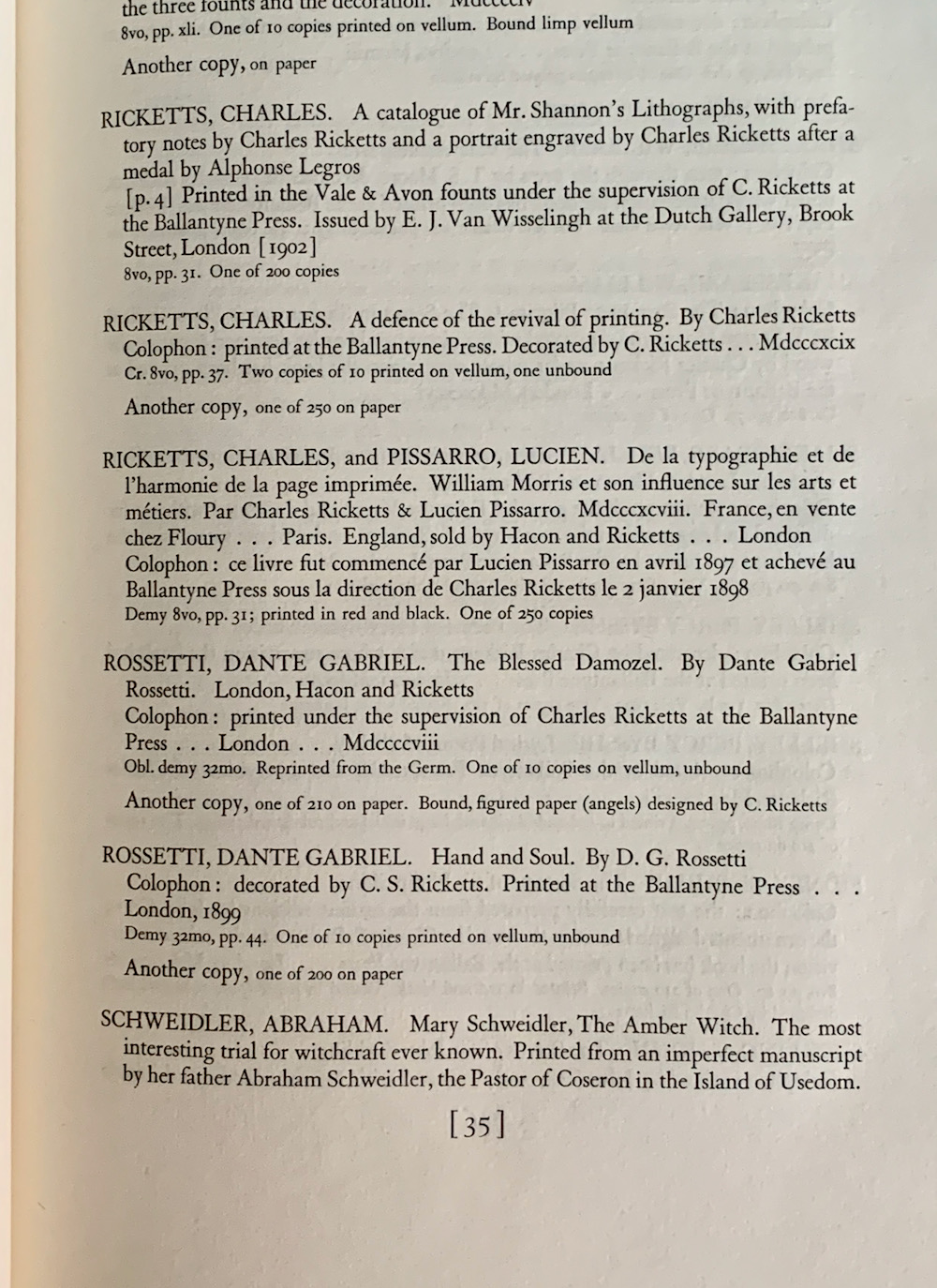
However, because of this, both vellum copies of Blake's Poetical Sketches are missing, and exactly the same goes for Ricketts's Defence of the Revival of Printing and Michael Field's The Race of Leaves. The impression of Astley's collection is thus a lot poorer, simpler, less complete than it actually was.

The Book Beautiful. Chas J. Sawyer Ltd., 1941,
catalogue No. 166, page 55
[The Grolier Club, New York]


Books not listed in Astley's library catalogue


Conversely, Sawyer's catalogue includes some Vale Press books not catalogued in 1928; Constance Astley probably acquired these between 1928 and her death in 1940.

The Book Beautiful. Chas J. Sawyer Ltd., 1941,
catalogue No. 166, page 9
[The Grolier Club, New York]

Maurice Guérin's The Centaur. The Bacchante is described in Astley's catalogue as an ordinary copy, and it is described in Sawyer's catalogue on page 57 (no. 163): 'With woodcuts, 8vo, buckram'. But on page 9 - in a section for 'Superb Modern Bindings' - a second copy is listed:

Niger morocco extra, broad gilt line borders enclosing blind tooling on sides, title of book stamped in blind on upper cover, gilt edges by Florence Paget with her initials and date 1902 on inside lower cover.

This - see previous blogs - is another book binding designed and executed by a female binder.

Although I noted earlier that, in 1928, Astley did not own any book bindings specially designed by Ricketts, she apparently acquired one later. Sawyer describes a special copy of Constable's Poems and Sonnets (not in the special section for bookbindings, but in the Vale Press section):

white pigskin, gilt and blind tooled to a design by C. Ricketts

The Book Beautiful. Chas J. Sawyer Ltd., 1941, catalogue No. 166, page 56
[The Grolier Club, New York]

One copy of this book in such a binding is known to exist, and it is now part of Houghton Library, Harvard Library, Cambridge.

Present locations of books from Astley's collection


The above copy of Constable's Poems and Sonnets in Harvard may once have been Constance Astley's - unless several copies (unknown to me) feature this Ricketts-designed pigskin binding.

The two volumes of Tennyson's poems, bound by Sarah T. Prideaux, either ended up in the British Library or in Duke University Library (where, incidentally, only one of the two volumes is found).

The Book Beautiful. Chas J. Sawyer Ltd., 1941, catalogue No. 166, page 10
[The Grolier Club, New York]

Beyond these two items, it cannot be determined at all in which libraries her Vale Press books ended up. (Some other private presses numbered all copies and, with a lot of patience,  these can be traced back to her collection.) 

This lavish private collection, which led a semi-secret existence during the collector's lifetime, ended up in an untraceable collection after her death. A journey from invisibility to obscurity.

Note
Thanks are due to Scott Elwood, The Grolier Club, New York, for providing scans of the Sawyer catalogue.

Wednesday, March 1, 2023

604. A Vale Press Collector: Constance Astley (4)

In the catalogue of Astley's collection, The Ashendene Press takes up five pages; The Daniel Press just over one, The Doves Press six; The Eragny Press five-and-a-half, The Essex House Press eight and The Kelmscott Press three-and-a-half. Ricketts's Vale Press also covers the maximum of almost eight pages (pp. 30-37).

Her general collection included other Ricketts-designed books, such as Thomas Hardy's Tess (1891), Wilde's De Profundis (1905) and Shaw's Saint Joan (1924), but his two main commercial designs from the 1890s were missing: Wilde's The Sphinx and John Gray's Silverpoints. 

On the other hand, she did own copies of the two celebrated predecessors of the Vale Press, the editions of Daphnis and Chloe (1893) and Hero and Leander (1894), and the five issues of The Dial (1899-1897).

The Vale Press

Astley's Vale Press collection was described in forty-seven entries. In this section, too, multi-volume works are included as one item. Thus, the thirty-eight-volume Vale Shakespeare is documented in one brief catalogue description.

The Vale Press, like the Doves Press, must have been among her favourites - the collection was entirely complete. Not one edition was missing. All ninety volumes were present.

Moreover, multiple copies were acquired in many cases, adding another thirty-four books to her Vale Press collection that comprised 124 volumes, five or six shelves at least.

The earliest editions of the press and the later Vale Shakespeare were only printed on paper, there were no vellum editions of those books. However, there were thirty-six volumes printed on vellum, and Astley's bookshelves carried no less than seventeen copies printed on vellum. Three of those were accompanied by a second copy on vellum: twenty in all. Not bad for a collector without a system, she owned almost half of all existing vellum Vale Press editions. By now we can establish that her system of collecting private press editions was simple: don't miss an opportunity, buy all the copies you come across.

Catalogue of the Library of Constance Astley
at Brinsop Court Herefordshire
(1928)

Astley mostly left the books in their original condition. The vellum copy of Thomas Browne's Religio Medici, for example, was 'One of 10 copies printed on vellum. Unbound.' We can hope that later owners left it that way, but I dread the worst: unbound copies of vellum editions are now extremely scarce.

Remarkably, Astley did not own a single copy in a unique book binding specially designed by Ricketts for a Vale Press book. However, there were a few Vale Press books in bindings by leading contemporary bookbinders, and, although few in number, all by women bookbinders.

Of Robert Browning's Dramatic Romances and Lyrics, Astley owned a copy on vellum bound in blue morocco - probably not after a design by Ricketts, and also a paper copy in a binding by 'Miss T.C. Yeatman', as well as another copy on paper, probably in the original white cloth binding. The Yeatman binding was probably commissioned by Astley, as it contains an autograph letter from the binder (according to the Sawyer 1941 sale catalogue).

Alfred Tennyson, In Memoriam (Vale Press, 1900)
Binding (detail) by Sarah T. Prideaux
[Collection: British Library, London]

At the time the Vale Press was publishing a two-volume Tennyson edition, bookbinder Sarah Prideaux bought two copies which she bound. One set is now in the British Library, the In Memoriam volume of the other set ended up in Lisa Unger Baskin's collection and has since been transferred to Duke University Libraries in Durham, North Carolina. One of these must have been Astley's copies.

Alfred Tennyson, In Memoriam (Vale Press, 1900)
Binding by Sarah T. Prideaux
[Collection: Duke University, Durham:
from the collection of Lisa Unger Baskin]


Exceptional vellum copies

The books of which she managed to obtain two copies on vellum are:

William Blake, Poetical Sketches (1899): 'Two copies of 8 on vellum'.
Charles Ricketts, A Defence of the Revival of Printing (1899): 'Two copies of ten printed on vellum, one unbound';
Michael Field, The Race of Leaves (1901): 'Two copies of ten printed on vellum. One unbound'.

Catalogue of the Library of Constance Astley
at Brinsop Court Herefordshire
 (1928)

Exceptionally, Astley managed to secure a vellum copy of Michael Field's The World at Auction (1898) - there were only two printed like this. One was left by Charles Shannon and sold in 1937. This cannot have been Astley's copy, as her catalogue was printed in 1928. Copies were sold in 1946 and 1994, these may have been either Shannon's or Astley's copies. The location of one vellum copy is known (to me): Clark Library, UCLA, Los Angeles, California. This copy is bound in green morocco. My guess is that this once was Shannon's copy (and, earlier, Ricketts's copy).

Constance Astley ranks among the absolute top Vale Press collectors of the twentieth century.

Wednesday, February 22, 2023

603. A Vale Press Collector: Constance Astley (3)

Constance and Hubert Astley made long voyages to Tenerife, Egypt and America. A family house was located on Lake Como in Italy where they sometimes stayed for months; there were yacht parties, dinners and guests at Benham Valence. But when did she buy her books? How much time did she spend on collecting them? From whom did she acquire the luxury editions of private presses?

About her activities as a collector, we know nothing at all - we only know the 1928 interim result thanks to the catalogue of her collection and the state of her complete collection thanks to the sale catalogue issued after her death by Sawyer in 1941. Perhaps a comparison between the two could provide additional information?

Visitors Book The Cotswold Gallery
[Private collection]

Thanks to the guest book of a London art gallery, the Cotswold Gallery (private collection), we know that her husband Hubert D. Astley visited that gallery on 23 March 1922 (Ricketts signed the guestbook for the first time in April of that year). Was Constance Astley visiting antiquarian booksellers elsewhere in London while he devoted himself to art?

Visitors Book The Cotswold Gallery
[Private collection]

The Ashendene Press

The Ashendene Press, founded by St John Hornby (1867-1946), was still active when Astley published her catalogue in 1928. By then, thirty-six (out of a total of forty) books had already been published. Astley did not have them all. 

In fact, she owned twenty-three editions and of half of them she owned multiple copies. Of Tutte le opera di Dante Alighieri Fiorentino, for example, she owned three copies; one of six on vellum and two of 106 on paper.

The oldest edition she owned of this press was published in 1899 - she apparently did not find the previous nine editions interesting.

Of the thirty-five copies in her collection, nineteen were on vellum.

The Daniel Press

The Daniel Press founded by Charles Henry Olive Daniel (1836–1919) and members of his family issued fifty-eight books of which Constance Astley owned thirteen books in 1928, including the very rare edition of The Garland of Rachel (1881) of which thirty-six copies were printed.

The Doves Press

T.J. Cobden-Sanderson and Emery Walker's Doves Press issued forty books between 1900 and 1916. Astley owned forty-one books, including one ephemeral publication (Ecce Mundus). 

Astley's complete Doves Press collection totalled ninety-one copies; she often owned three copies of a book, sometimes two of which were on vellum. In her bookcase were copies of thirty-four Doves Press editions printed on vellum, with a second copy on vellum of nine of these. That brings the number of vellum copies, astoundingly, to forty-three. Many of these were bound by The Doves Bindery. One copy was bound by Edith J. Gedye (Essays by Ralph Waldo Emerson [as in the 1928 catalogue the name was often misspelt Gedge]). Gedye sometimes identified herself as a 'successor to Cobden Sanderson'. As a bookbinder, she started at Sangorski & Sutcliffe, and later settled in Bristol.

Gustave Flaubert, La légende de Saint Julien l'Hospitalier
(Eragny Press, 1900). Copy bound by Sarah T. Prideaux (detail)
[Collection British Library, London]


The Eragny Press

Lucien and Esther Pissarro's Eragny Press published thirty-two books. Astley owned twenty-nine of them. The two Eragny books commissioned by French bibliophile societies were missing: the Nerval edition for the SociĂ©tĂ© des Cent Bibliophiles and the Moselly book ordered by Le Livre Contemporain - obviously these were difficult to obtain in Great Britain. Also missing was the last book issued by Pissarro: Michael Field's Whym Chow (1914) of which a mere twenty-seven copies were printed. 

Many of these books were present in multiple copies. The entire collection consisted of sixty-one copies.

For example, the three-volume Flaubert series (1900-01) was present in triplicate, with one set bound by Sarah T. Prideaux. At publication, Prideaux bound two such sets whose patrons are unknown. One of these sets is in the British Library (illustrated in Marianne Tidcombe's Women Bookbinders 1880-1920, 1996, p. 108; for colour illustrations see the BL Database of Bookbindings).

Astley acquired ten books of the press that were printed on vellum - of two of these books she owned two vellum copies.

Essex House Press

The Essex House Press was founded by C.R. Ashbee in 1898. The presses were sold in 1910 when ninety books had been published. Constance Astley owned fifty-two books of this private press. 

Again, Astley collected multiple copies. Her Essex House row of books numbered sixty-three copies. Among them were eighteen books printed on vellum, but that is not exceptional in this case - twelve of these were part of editions of which the press only issued copies on vellum.

The Kelmscott Press

William Morris published fifty-three books at The Kelmscott Press, if we include the few that were finally issued after he died. Astley owned only twenty-four of them, but her collection included a copy of the Chaucer edition, the largest undertaking of the press.

Duplicates included, there were twenty-six Kelmscott Press editions, of which there were four copies printed on vellum. Astley owned both a vellum and a paper copy of the Chaucer edition and of Rossetti's Hand and Soul, a vellum copy of Morris's Of the Friendship of Amis and Amile, and a vellum copy of The Tale of King Florus and the Fair Jehane. 

The Vale Press collection of Constance Astley will be the subject of next week's blog.

Wednesday, February 15, 2023

602. A Vale Press Collector: Constance Astley (2)

Following Constance Astley's death in 1940 - with her personal property valued at £58,151 - several auctions of household goods and books took place, including a two-day auction organised in 1944 by Russell, Baldwin and Bright held at Brinsop Court.
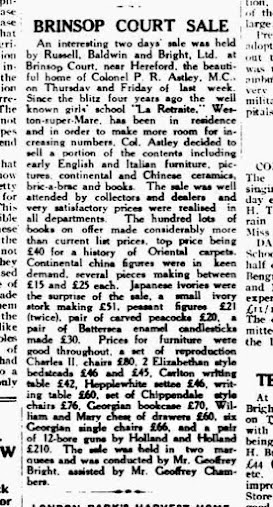
'Brinsop Court Sale'
(Kingston Times, 25 November 1944)

English and Italian furniture and Chinese pottery changed hands, but so did 'books', according to the Kingston Times (25 November 1944):

Two hundred lots of books on offer made considerably more than current list prices, top price being £40 for a history of Oriental carpets.

In 1947, her son, Colonel P.R. Astley, sold more antiques, including silver, glass, pictures and prints. (Kingston Times, 8 February 1947).

However, her collection of special editions of English private presses had left Brinsop Court earlier, shortly after her death. The entire collection was sold, without a preface about the collector, anonymously, in London by the antiquarian firm of Chas. J. Sawyer Ltd. in Grafton Street. The catalogue, dated 1941 and numbered 166, was entitled "The Book Beautiful" and the subtitle described the collection roughly as:

PRIVATE PRESS BOOKS
(Many Printed on Vellum)
Richly Decorated Bindings
Modern Illuminated Manuscripts
forming a part of a 
CHOICE LIBRARY JUST PURCHASED
interspersed with
Books of General Interest
eminently suitable for
Christmas and New Year Gifts

Constance Astley apparently never had a bookplate made - I have not found one example - not for her private press books or her ornithological books, nor for the general library at Brinsop Court. (An earlier occupant, Dearman Edwards, did paste one in his books.) Curiously, her young son from her first marriage apparently did have a bookplate. When he was ten years old, in 1901, they lived at Benham Valence Manor, and from his boarding school he wrote to her: 'Mr. Hansel the master in this form has got a collection of book plates, and wants me to give him one of mine, so please send me one for him when you get back to Benham' (Richard Vincent Sutton, A Record of his Life together with Extracts from his Private Papers, 1922, p. 11). This son later shared her habit or reading. During the Great War she sent him books; on 6 September 1918, he received The Mikado's Empire and a novel, and read the former 'which is interesting'. (p. 181, 184).

The absence of a bookplate makes it almost impossible to find out where her books went after her death and Sawyer's sale, with a few exceptions. (More on that in a following blog).

Catalogue of the Library
of Constance Astley
at Brinsop Court,
Herefordshire 
(1928)


Her own catalogue of the collection, Catalogue of the Library of Constance Astley at Brinsop Court, Herefordshire (1928) contains a preface in which Constance Astley says something but disappointingly little about her passion. For instance, we do not know when she started her collection of modern private press books.

The correct function of a preface of this sort is, I believe, by hints and suggestions to act as a guide to beginners in the fascinating pursuit of book collecting; but alas! I am incapable of this, as I have followed no system and had no arrière pensĂ©e as to future values - but merely followed my own personal likings. Many of the book bought in my youth, and even at a later date, are worthless from a monetary point of view. I well remember my excitement when for the first time in my life a present of money (£1, to be exact) was given to me, and how it was promptly spent on books! and ever since that day any available cash has always gone the same way.

Catalogue of the Library of Constance Astley
at Brinsop Court, Herefordshire 
(1928)


She describes how collecting books for their content slowly turned into collecting books for their outward form.

From my childhood onwards I have been an omnivorous reader (I remember on one occasion getting through three books - not novels - on a journey to Italy), and I began by buying just the  books I wanted to read, with complete indifference as to print and format. Then I began to think of nice bindings to make my book-shelves decorative - after which I developed a taste for books well produced and pleasant to read and handle, and last of all came the love of fine printing, a passion which still holds me in its grip. 

Catalogue of the Library of Constance Astley
at Brinsop Court, Herefordshire 
(1928)


That section of private press editions dominates the 1928 catalogue and occupies the first thirty-seven pages. With her catalogue, she also, in a way, commemorates her (second) husband's hobby:

The ornithological section of my library owes its inception to my husband, Hubert Astley, whose knowledge and love of birds was well-known.

He probably never collected books, although he was said to be 'a finished linguist, artist, and connoisseur of many forms of art' (Richard Vincent Sutton, A Record of his Life together with Extracts from his Private Papers, 1922, p. 16). Constance Astley merely took her second husband's hobby as the starting point for a new nucleus in a growing book collection. While he was busy outside with his bird collection, she was studying inside the library.

At the end of her preface, she explains that she loved dogs and hunting immensely, but that her age now made such outdoor hobbies more difficult to pursue and that she was therefore all the more grateful to be able to read about these subjects in her library. She also hoped her legacy would inspire her son (from her second marriage):

... when he has out-grown his taste for the works of Edgar Wallace!

Apparently not. After her death, the shelves were soon emptied and the books left for London to be dispersed to all corners of the world.

Catalogue of the Library of Constance Astley
at Brinsop Court, Herefordshire 
(1928)


Sawyer knew that there was plenty of interest among passionate collectors of private press books. However modestly she spoke of the collection, she had collected almost all books from the important private presses. She denied it, but surely she had a 'system'! Her collection stood lonely at the top, containing almost all deluxe editions of the Ashendene Press, Daniel Press, Doves Press, Eragny Press, Essex House Press, Kelmscott Press, and Vale Press.

Note
Thanks are due to Scott Ellwood of the Grolier Club in New York who kindly provided scans of the 1941 Sawyer catalogue.

Wednesday, February 8, 2023

601. A Vale Press Collector: Constance Astley (1)

A wealthy but lesser-known collector of the Vale Press was Constance Astley. There are few records about her.

Incidentally, there are at least two Constance Astleys, one of whom lived from 1851 to 1935, a traveller and diarist whose full name was Constance Charlotte Astley. She travelled extensively through New Zealand; her family lived at Arisaig House on Arisaig Island, Scotland.

She was not the collector of books.

Brinsop Court, near Hereford

The bibliophile's name was Constance Edith Corbet (1866-1940). She married Sir Richard Francis Sutton (born 1853) in 1888. From this marriage a son was born in April 1891, a few months after Sutton's death in February. This was such a severe blow that Constance suffered from a near suicidal depression (see Calderonia). Her son Richard (Dick) Vincent Astley would die in France when on active service just after the Great War; he died of influenza on 29 November 1918, and was buried in Haaltert (Belgium).

In 1895 Lady Constance Sutton born Corbet married the reverend Hubert Delaval Astley (1860-1925). With him, she had two children, a son (Philip Reginald Astley who lived from 1896 to 1958) and a daughter (Ruth Constance Astley who lived from 1900 to 1984). Since her second marriage, Constance was called Constance Astley. In 1912, the Astleys bought a thirteenth-century house, Brinsop Court near Hereford, and they had it renovated, restoring the gardens and adding an extension to the house.

Hubert Astley was a keen ornithologist, an editor of and regular writer for the Avicultural Magazine, and author of My Birds in Freedom and Captivity (1900). After his death, Constance continued his collection of live birds, and became a member of the British Ornithologists Union.  

A portrait of Constance Astley appears to have been made by Augustus John in 1913. It was sold by Christie's in 2015 and can be viewed here, on Christie's website. Incidentally, it is not entirely certain which Astley was depicted by the artist: the bibliophile was about 47 years old in 1913, the older traveller was 62. It is likely that the portrait is indeed of the bibliophile.

Constance Astley published three books: one about her first son: Richard Vincent Sutton. A Record of his Life together with Extracts from his Private Papers (1922), one about her dog, containing text by her second husband: The Memoirs of No-nosi, a Prize-Pekingese (1931) - and, in between, a book about her library was printed: Catalogue of the Library of Constance Astley at Brinsop Court, Herefordshire (1928). All were designed and printed for her by George W. Jones at the Dolphin Press in London. It is supposed that only about fifty copies of each book were issued. 

Richard Vincent Sutton (1891-1918)


After her second husband died, she remained at Brinsop Court were her library was located. The catalogue of her collection - set in Linotype Grandjon Old Face and Civilité type and printed on handmade paper in a large format - contains quite a few 'Books on Birds and other Natural History Books' listed on pages 245 to 273. The 'General Collection' is described on pages 49-244. However, in regard to Ricketts the first fifty pages are of significance. These show the depth of her collection of books on book bindings and bookplates - and, extensively, the private presses section of her library.

Wednesday, February 1, 2023

600. The Art Collection of Ricketts and Shannon

Blogpost number 600 is a contribution written by Helen Ritchie, Senior Curator Modern & Contemporary Applied Arts at the Fitzwilliam Museum, Cambridge. She studied at Trinity Hall, University of Cambridge and the University of the Arts London. She joined the Fitzwilliam in 2016, and has been responsible for the exhibition Designers and Jewellery 1850-1940: Jewellery and Metalwork from The Fitzwilliam Museum (2018), writing the accompanying catalogue, and she has curated other exhibitions. In 2020, she published the article 'The Portrait Jewels of Charles Ricketts (1866-1931)' in Jewellery Studies. The Journal of The Society of Jewellery Historians (read the text online). I am very grateful to her for this blog essay about the art collection of Ricketts and Shannon.


The Art Collection of Ricketts and Shannon


Although better-known as a designer, illustrator, painter and sculptor, Charles Ricketts was not only a producer of art, but a consumer and collector of it too. Together with his partner, artist Charles Shannon, Ricketts amassed an enormous, eclectic art collection, which encompassed Classical and Egyptian antiquities, Japanese woodblock prints, ‘old master’ drawings, and works by more contemporary artists such as Rossetti and Burne-Jones. Ricketts was avid in his attendance of sales at auction houses and dealers' warehouses and had an excellent eye, making use of his formidable memory and extensive knowledge of art to pick up bargains and as-yet unattributed works. The collection mirrored the breadth of Ricketts and Shannon's interests, as recorded by Ricketts in 1900: 


Tuesday. Looked through more of those perfect prints belonging to a German, in this case in the hands of a thief who asked Bing prices for them. Bought 2: one Outamaro, & one Harunobu. I think at their best that nothing quite touches a first rate Jap print, excepting a good greek Kylix or first rate Tannagra, even the latter hardly compare, only the masterpieces of the greatest masters go beyond; picked Titians or Rembrandts or world famous frescoes.
[Charles Ricketts, diary, 30 October 1900, BL Add MS 58098] (See also Self-Portrait, 1939, p. 47]

During the 1890s, Ricketts and Shannon focused on acquiring artworks that were less popular and thus more affordable, in particular, antiquities and Japanese woodblock prints. During the first half of their lives, money was in relatively short supply and Ricketts's diary and correspondence are filled with the agonies of deciding how much to spend on artworks, whether they could afford such sums, and the unreliability of buying at auction houses. He wrote, 'I wish treasure turned up in shops and not in sale rooms' [Diary 22 February 1901, BL Add MS 58099. See also Self-Portrait, 1939, p. 54]. Friend Cecil Lewis described the 'skimping' and 'saving' that enabled Ricketts and Shannon to save up to acquire artworks, and them selling only 'with the greatest reluctance', for example, in 1929, when Ricketts sold their entire group of Persian paintings in order to raise funds for Shannon's medical care. Large-scale oil paintings were often out of reach financially, although sacrifices were made in order to acquire some, including Piero di Cosimo's 'Lapiths and Centaurs' (1500–15), purchased by Ricketts and Shannon in 1904 for £500, just after it had been refused by the Louvre (later bequeathed to the National Gallery), and Alfred Stevens's portrait of Leonard W. Collmann (1854), which was purchased for £300.

Piero di Cosimo, 'The Fight between the Lapiths and the Centaurs' (1500-15)
[Photo/Collection: National Gallery, London]
[Creative Commons Attribution-NonCommercial-ShareAlike 4.0 International
(CC BY-NC-SA 4.0) license]


Alfred Stevens, 'Leonard W. Collmann' (1854)
[Photo/Collection: The Fitzwilliam Museum, Cambridge]
[Creative Commons Attribution-NonCommercial-ShareAlike 4.0 International
(CC BY-NC-SA 4.0) license]

Throughout their lives, the collection was displayed in their homes at Kennington Park Road, the Vale, Beaufort Street (both in Chelsea), Spring Terrace in Richmond, Lansdown House in Kensington, Townshend House in Regent's Park, and in their country retreat, the Keep at Chilham Castle, Kent. Matt Cook (see 'Further Reading' below) has written extensively on the aesthetics of the homes of Ricketts and Shannon, and how their collection brought them together, drawing on the numerous comments made by contemporary visitors, who noted the collection and its arrangement. Although many rooms were ascetic in their sparse decoration, according to Cecil Lewis, certain rooms were arranged like 'a small museum':

Egyptian antiquities, Greek vases and figurines lived in glass cases. Below were drawers full of antique beads and Chinese hair ornaments […]; there were Adam sofas and chairs, Italian side-tables, a marble torso, a bas-relief, a picture of Don Juan by Ricketts, a portrait of [the actress] Mrs Pat[rick Campbell] by Shannon… But this room was never lived in. Days would pass when it was not visited. It was open only when they received, when friends who cared to see, and would understand its rarity, were shown round. Yet it was not, like a museum, cold and detached. It was a set piece, true; but it was none the less a room. Arranged in perfect taste. 
[Cecil Lewis, 'Preface' in Self-Portrait (1939), p. ix]

Given the money, time and attention lavished on the collection, and its important role in the construction of the identities of both Ricketts and Shannon as individuals, and as a couple, it was important that plans were made for its future. Therefore, Ricketts arranged that on his and Shannon's death, most of the collection (comprising more than one thousand works) would be left to various museums. Some of the paintings were bequeathed to the National Gallery, London, and more than 300 Japanese woodblock prints, mostly collected by Shannon, were left to the British Museum under the guardianship of their friend, Laurence Binyon, who was Keeper of the Prints and Drawings Department there until 1933.

Kitagawa Utamaro, woodblock print from the series: Fujin Tewaza Juni-Ko (1790s)
[Photo/Collection: British Museum, London: 1937,0710,0.96]
[Creative Commons Attribution-NonCommercial-ShareAlike 4.0 International
(CC BY-NC-SA 4.0) license]

However, the bulk of the collection was left to The Fitzwilliam Museum, University of Cambridge, on the advice of Sydney Carlyle Cockerell (1867–1962), Director of the Fitzwilliam between 1908 and 1937. Cockerell was a great friend of Ricketts and Shannon, often borrowing works from their collection for display in the Museum and receiving 'tip offs' from Ricketts on bargains he had come across. After Ricketts's sudden death in 1931, much of the collection was lent to The Fitzwilliam and bequeathed permanently to the Museum on Shannon's death in 1937. 

In the Museum's Annual Report of 1937, the bequest is listed as follows:

Bequeathed by Charles Hazelwood Shannon, R A:

The Ricketts and Shannon Collections:

The collection of Egyptian antiquities.

The collection of Greek and Roman antiquities, including fine black- and red-figure Greek vases.

47 Classical gems.

15 paintings of the Italian, Flemish, French and English schools.

426 drawings and watercolours by old and modern masters of the Italian, Flemish, Dutch, German, Spanish, French and English schools, including fine examples by Titian, Tintoretto, Tiepolo, Rubens, Van Dyck, Rembrandt, Goya, Watteau, Rowlandson, Stevens and Burne-Jones.


A bronze head of Shannon, by Lilian T. Wells. [This is by Reginald Fairfax Wells]

68 engravings, including work by Goya, Keene and Legros.

A miniature of a child, attributed to Fragonard.

4 pieces of Italian majolica, 16th century.

A Meissen dish, c. 1765.

5 brass dishes, German, 15th century.

A piece of Persian embroidery.

41 Japanese drawings, including works by Hokusai.

A gold locket containing hair of Swinburne and Rossetti.

A satinwood side-table, English, late 18th century.

A mirror in a painted frame.


The collection of around 190 Greek and Roman antiquities included the extremely important bust of Antinous as Dionysos, unearthed from Hadrian's villa at Tivoli, but it was the drawings in particular that were praised for their quality. 


Rembrandt, 'The Supper at Emmaus' (1640-41)
[Photo/Collection: The Fitzwilliam Museum, Cambridge]
[Creative Commons Attribution-NonCommercial-ShareAlike 4.0 International
(CC BY-NC-SA 4.0) license]

The Museum's Annual Report continues:

The bequest of Charles Shannon has greatly enriched the Department [of Pictures and Drawings] in all sections, but especially in that of old-master drawings. Titian's Jupiter and Io, Rembrandt's Christ at Emmaus, and the finest of the drawings by Rubens and Watteau are masterpieces unsurpassed in their kind. The collection also contains numerous other drawings, both by old and modern masters, of the finest quality. Among the paintings may be specially mentioned those by Nardo di Cione, Bicci di Lorenzo and Jacopo del Sellaio, Archbishop Laud from the studio of Vandyck (one of nine known versions), and the portrait of Leonard Collmann by Alfred Stevens.

Anthony van Dyck, 'Archbishop Laud' (c.1635-37)
[Photo/Collection: The Fitzwilliam Museum, Cambridge]
[Creative Commons Attribution-NonCommercial-ShareAlike 4.0 International
(CC BY-NC-SA 4.0) license]

The collection included a range of works by nineteenth-century French artists, including Delacroix, Barye, Millet, Puvis de Chavannes and Rodin, but none of the Impressionists, whose work Ricketts detested. He was also a great admirer of some nineteenth-century English artists, especially Dante Gabriel Rossetti and Edward Burne-Jones. Ricketts acquired one of Burne-Jones's earliest large-scale pencil drawings, 'The Backgammon Players' (1861) from collector (and fellow donor to the Fitzwilliam Museum), Charles Fairfax Murray, who as Burne-Jones's first studio assistant, had been drawn into the Pre-Raphaelite circle. Burne-Jones later painted the same scene in watercolour (now in the collection of Birmingham City Museum and Art Gallery) and on a cabinet made by Philip Webb (now in the collection of the Metropolitan Museum of Art, New York).

Edward Burne-Jones, 'The Backgammon Players' (1861)
[Photo/Collection: The Fitzwilliam Museum, Cambridge]
[Creative Commons Attribution-NonCommercial-ShareAlike 4.0 International
(CC BY-NC-SA 4.0) license]

Rossetti’s drawing, 'Mary Magdalene at the door of Simon the Pharisee' (1858) had long been thought lost before it was rediscovered by Ricketts, who purchased it sometime before 1890.

Dante Gabriel Rossetti, 'Mary Magdalene at the door of Simon the Pharisee' (1858) 
[Photo/Collection: The Fitzwilliam Museum, Cambridge]
[Creative Commons Attribution-NonCommercial-ShareAlike 4.0 International
(CC BY-NC-SA 4.0) license]

Ricketts's prodigious knowledge was widely acknowledged by his peers – he acted as art advisor to the National Gallery of Canada (1924–31) and to individuals including Sir Edmund Davis, who gave Ricketts and Shannon the Keep at Chilham Castle for life in return for the excellent advice Ricketts had given him on buying profitable pictures. In 1915, Ricketts had been offered and declined the Directorship of the National Gallery, London, a decision that he bitterly regretted, writing in his diary, 'I have been an ass' (Self-Portrait, p. 261, diary 16 June 1916). 

Ricketts was more active than Shannon in the acquisition of artworks but their collection was an entirely joint venture, the two men using conjoined ‘C’s as their collectors’ mark. The collection was at the heart of their lives, connecting their professional and artistic activity with their domestic life together at home. At the lowest point in their relationship, when it seemed that Shannon might leave Ricketts for the sculptor, Kathleen Bruce (1878–1947), Ricketts invoked their art as an important reason to stay together, exclaiming, 'And what would become of the collection?' (quoted in Michael Field’s journal, 19 October 1907). It is also a sad irony that the collection was the cause of Shannon's fall in 1929 and subsequent disability – he fell while trying to hang a picture on the stairs.

However, it is important to note that the joint nature of the collection has often been occluded in the documentation of these objects due to institutional technicalities and procedures. As Shannon was the last of the two men to die, and therefore the collection was bequeathed to museums by him as an individual, many objects appear in museum collections as 'Bequeathed by Charles Shannon, 1937', with no reference at all to Ricketts. This masks the key role that Ricketts played in piecing together the collection, and ignores the role of the importance of the collection in the construction of Ricketts's and Shannon's relationship. Given that Ricketts was particularly sensitive to this sort of detail, berating Cockerell for labelling jewels in the Fitzwilliam as having belonged to 'Misses Bradley & Cooper' instead of by their preferred singular pseudonym of Michael Field (letter from Ricketts to Cockerell, dated 6 June 1917, British Library, Add MS 52746, no. 58), it undoubtedly would have distressed him to think that his and Shannon's collection would have been similarly incorrectly credited.

Indeed, shortly after the bequest was formalized, the objects were installed in the Fitzwilliam Museum with only Shannon's name appearing on the object labels. This was noticed immediately by friends of Ricketts and Shannon. The Museum's archive contains a letter dated 24 October 1937 from Thomas Sturge Moore to then-Fitzwilliam Museum Director, L. C. G. Clarke. In it, Moore writes of Ricketts and Shannon, 'Their friendship, like their collection, was unique and they regarded its designation by their joint names as their monument.' For Ricketts and Shannon, their collection was intended to be their joint legacy, recording their partnership for posterity.

This letter, and its reply, was highlighted recently by participants in the University of Cambridge Museums' Remix programme and, read aloud in full, formed the basis of a creative response to Edmund Dulac's portrait of the pair as medieval saints, which is also in the Fitzwilliam's collection. In light of this evidence and the clarity of their wishes, it behoves Curators at the many institutions that benefitted from their generosity to ensure that both Ricketts and Shannon are credited with the creation of their unique and important art collection.
                                                                                                                Helen Ritchie


Further reading on the art collection of Ricketts and Shannon:

Stephen Calloway, ''Tout pour l'art': Charles Ricketts, Charles Shannon and the Arrangement of a collection' in The Journal of the Decorative Arts Society 1890-1940, no. 8 (1984), pp. 19–28.

Matt Cook, 'Domestic Passions: Unpacking the Homes of Charles Shannon and Charles Ricketts' in Journal of British Studies, vol. 51, no. 3 (2012), pp. 618–640.

Joseph Darracott, All for Art: The Ricketts and Shannon Collection. Cambridge , Cambridge University Press (for) Fitzwilliam Museum, 1979.

Caroline Elam, 'Piero di Cosimo and Centaurophilia in Edwardian London' in The Burlington Magazine, vol. 151, no. 1278 (2009), pp. 607–615.

Jane Munro, 'CR and Charles Shannon collectionneurs de dessins' in Catherine Monbeig Goguel (ed.), L'Artiste collectionneur de dessin II. Paris, SociĂ©tĂ© du Salon de Dessin, 2007, pp. 149–60.

Christina Rozeik, '"A maddening temptation" The Ricketts and Shannon Collection of Greek and Roman Antiquities' in Journal of the History of Collections, vol. 24, no. 3 (2012), pp. 369–378.

Note
For the transcription of Ricketts's diary notes, the editor wishes to thank John Aplin.